Make an informed choice
EmDash vs Contentful: An Astro Website or a Shared Content Platform?
A practical comparison of an integrated Astro CMS and a shared content platform, covering editorial work, operating costs and migration.
By DashHarbor · Published · Updated
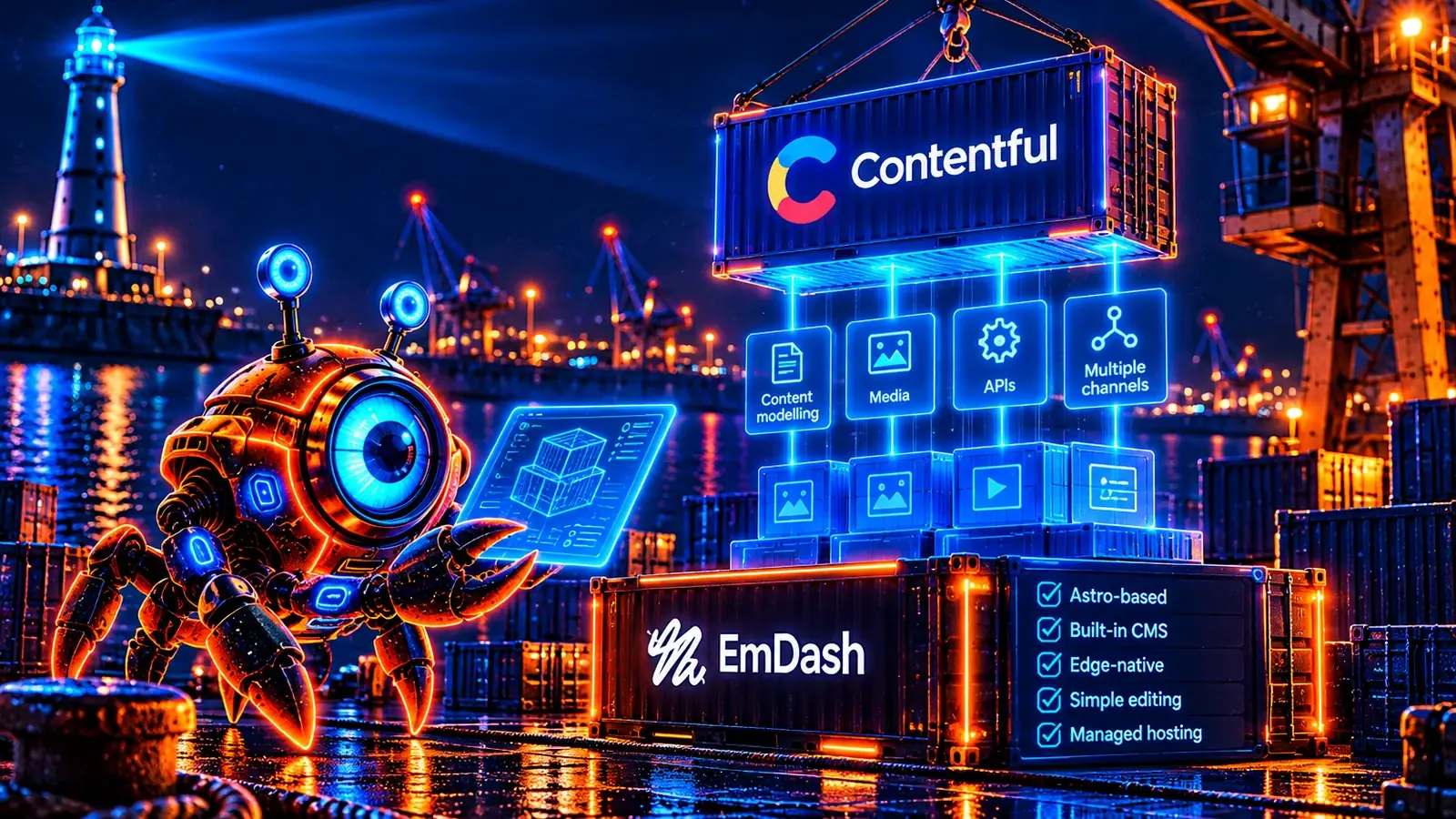
EmDash and Contentful can both give editors structured content and developers control over the website. The important difference is where that content system sits. EmDash belongs inside an Astro application. Contentful is a separately operated content platform that your website, app or other service consumes through APIs.
That distinction matters more than a checklist of editor buttons. A small team maintaining one business website has different needs from an organization distributing product information across websites, mobile applications and regional teams. Neither architecture is automatically faster, cheaper or easier to govern.
This guide considers ordinary publishing, development and operating responsibilities. Official documentation and plan information were reviewed on 26 October 2026. Recommendations are architectural assessments, not performance benchmarks or a claim that every upstream capability is included in DashHarbor.
The short version
Choose Contentful when a shared content service, delivery APIs and organizational workflows are central to the project. It is particularly worth evaluating when several independent applications need the same content and different teams own the frontends.
Consider EmDash when the principal product is an Astro website and you want its public pages, editor and content runtime operated together. This can reduce the number of application boundaries you maintain, while leaving you responsible for the application and its dependencies.
If an existing Contentful implementation works well, a smaller hosting bill alone is a weak reason to rebuild it. Account for content modeling, preview, integrations and editor retraining before making that decision.
EmDash vs Contentful at a glance
Requirement | EmDash | Contentful |
|---|---|---|
Application model | CMS within an Astro application | Hosted content platform consumed through APIs |
Public website | Astro routes and components | A separately implemented frontend |
Content structure | Collections, fields, relationships and rich text | Content types, entries, references and assets |
Editorial experience | Admin and publishing workflow supplied by the installed application | Contentful web application, with plan-dependent workflow features |
Preview | The site implements its supported native preview route | Preview APIs and frontend integration; live preview needs setup |
Hosting responsibility | Operate the application, database and media, or choose a provider | Contentful operates its platform; the frontend still needs hosting |
Multiple channels | Possible through application APIs and integrations | A natural use of its dedicated delivery platform |
Cost questions | Hosting, maintenance, integrations and development | Subscription scope, usage, frontend hosting and integration work |
Likely fit | A focused Astro website with an accountable operator | Shared structured content across applications and teams |
Architecture: where does the website live?
The EmDash architecture documentation describes a CMS runtime shared by the admin, Astro pages, database and media storage. A developer can query content from the application that renders the page. A supported dynamic publishing setup can show changed content without rebuilding the entire site.
Contentful's Content Delivery API supplies published content as JSON and delivers assets separately. The application still decides which content becomes a page, how references are resolved and when caches are refreshed. Contentful also documents separate management and preview APIs; they are different responsibilities, not interchangeable credentials.
For one marketing website, a shared runtime can make ownership easier to explain: one application release has to work with its content model. For a portfolio of independent applications, a dedicated content service can be the more useful boundary. The website can change frameworks without requiring the content service to become part of that new application.
Do not read that as a guarantee of effortless portability. Both approaches accumulate content structures and integration assumptions. The better architecture is the one your team can keep understandable as the project changes.
Content modeling and editorial work
Contentful organises work through spaces and environments, with content types describing entries and their relationships. Its domain model is worth understanding before designing reusable content. An article, author, product and landing-page section should have relationships that make sense outside one particular screen.
EmDash similarly requires decisions about collections and fields. A structured service record is useful when the website needs repeatable information. A rich-text body is useful when the author needs room to explain a topic. Neither CMS makes an overcomplicated model pleasant to edit.
Try a concrete task during evaluation: create a service page, reference a team member, add an image, save a draft, preview it and publish it. Then ask someone unfamiliar with the implementation to correct one sentence. Observe where they need help. This is a suggested evaluation, not a test we have performed inside a paid Contentful account.
Contentful may justify its extra platform boundary when its modeling and organizational features support several teams. EmDash may be the more direct fit when the fields exist primarily to power one Astro site. Review the actual editor configuration rather than judging either product from an ideal demonstration.
Preview, approvals and keeping drafts private
Contentful's live preview documentation describes side-by-side editing, live updates and inspector features. Those depend on connecting the frontend correctly. A subscription alone does not teach a custom page how to render unpublished references.
EmDash documents a separate save-and-publish workflow. The implemented theme, collection features and runtime determine what editors can preview. A saved draft should remain distinct from the page visitors see.
In either system, evaluate more than the happy path. Can an editor share a preview safely? Does an image change stay private until intended? Who may publish? What happens if two people edit the same entry? Formal approval or audit requirements should be checked against the exact supported configuration and plan, not inferred from the existence of a Publish button.
Hosting, deployment and reliability
Contentful takes responsibility for operating its content platform. You still operate the frontend, integration credentials, redirects, forms and any external services attached to the site. A static frontend may require a build after publication; a dynamically rendered frontend may fetch at request time. Cache invalidation is a design decision in both cases.
EmDash supports documented Cloudflare deployment and Node.js deployment paths. Cloudflare is an option, rather than a requirement that every EmDash site uses the same infrastructure. Database and media protection still need an owner.
For either choice, write down a recovery scenario before launch. If a release breaks an article template, can you restore working code without losing new entries? If a content change is wrong, can you recover it without rolling back the whole application? Software, content and media require related but distinct recovery decisions.
Our managed hosting guide explains the operational side of an EmDash website. It should be considered separately from the features of Contentful's SaaS platform.
Pricing: compare the complete operating cost
Start with Contentful's current pricing, including the space, user, locale, workflow and usage requirements that apply to your project. A plan suitable for evaluation may not include the permissions or operational commitments your organization needs.
Then add frontend hosting, search, forms, email, monitoring and the developer time required to maintain integrations. Include preview setup and model changes in the estimate. These costs do not disappear because the CMS platform itself is hosted.
For EmDash, evaluate application hosting, database and media usage, backups, support and software maintenance. Open-source software does not provide those services automatically. A managed provider may bundle some responsibilities, but its actual service boundaries matter.
Build an estimate around your own workload: editors, published entries, environments, traffic, asset delivery and expected changes. Avoid comparing an experimental EmDash deployment with an enterprise Contentful contract, or a Contentful evaluation plan with a fully supported production service. The scopes must match before the totals mean anything.
Ecosystem and integration work
Contentful offers an App Framework, delivery tooling and integrations around its content service. EmDash offers plugins and Astro development around the application. An integration's existence is only the beginning of the evaluation.
For a CRM connection, for example, check what is synchronised, which system owns the data and how failures are retried. For localization, check how translated content is reviewed and how missing translations appear. For search, check when an updated page reaches the index.
Contentful's environments can isolate content-model work, but they also introduce promotion and configuration decisions. A focused EmDash site may need less coordination; a more complex one still needs a disciplined way to evolve its schema and code.
Security, access and organizational controls
Contentful publishes a security overview and documents roles and permissions. Check the requirements of your actual contract: platform assurance does not automatically cover a custom frontend or an overly powerful integration token.
With EmDash, the operator controls application deployment and must protect its admin, secrets, database and media. Upstream authentication and plugin capabilities should be evaluated in the installed configuration. Do not infer that a newer CMS cannot have vulnerabilities.
A useful security review identifies who can change content, who can publish, who can change the model and who can deploy code. Give integrations only the access they need. The choice of CMS does not remove the need to review permissions when staff or suppliers change.
AI tools and developer experience
EmDash documents AI tools and an MCP interface for authenticated content operations. Availability in an upstream project does not mean every hosting provider enables or supports every connected assistant. Confirm that separately.
Contentful offers AI Actions for content-oriented work such as drafting, adaptation and translation. Verify entitlement, usage and review controls for the plan being considered. It would be inaccurate to frame this comparison as AI on one side and no AI on the other.
The practical question is what an assistant is allowed to do and how its output is checked. Generating copy is different from publishing it; suggesting a content model is different from safely changing a production one. Human review, scoped credentials and recoverable changes remain useful in either architecture.
Migration: move the content and rebuild the assumptions
Contentful's CLI import and export tools provide a starting point for moving structured data. An export does not turn a Contentful application into an EmDash theme. References, rich-text nodes, assets, locales and integrations still need mapping.
Before switching, inventory the URLs that receive traffic, the content types in use and every external system that reads or writes entries. Prototype a representative page with references and media. Check the new canonical, metadata and redirects before scheduling the remaining work.
Preserve the old system until the new site has passed acceptance and a rollback decision is clear. Avoid making the final content export the first time you discover a missing field or asset. The same principle applies when moving in the other direction: a working frontend is more than its content records.
Choose EmDash if your main product is an Astro website
EmDash deserves a place on the shortlist when one site is the centre of the project, your developers want Astro and you can assign clear responsibility for operation. It can be attractive when a separate content-platform integration would add little value.
Choose it for those needs, not for an assumed guarantee of zero maintenance. Check the theme, required integrations and publishing workflow on the environment you would actually use.
Choose Contentful if shared content and organizational scale matter more
Contentful is the stronger candidate when several applications share structured content, teams need a common platform and its available governance features match the organization's requirements. A functioning Contentful setup may already provide coordination that would be expensive to recreate.
A smaller stack is not automatically a better stack. If the platform boundary solves a real organizational problem, retaining it can be the sensible choice.
Frequently asked questions
Can Contentful power an Astro website?
Yes. Contentful delivers content through APIs, and an Astro frontend can consume that content. The distinction is whether you want a separate content platform or a CMS that runs within the Astro application.
Is EmDash always cheaper than Contentful?
No. Compare equivalent workloads and support requirements. Development, hosting, integrations and maintenance can outweigh the subscription difference, especially during a migration.
Does Contentful include hosting for my custom website?
Its content service is hosted. Your separately built frontend and any application services still need an appropriate hosting arrangement. Confirm the complete scope of any additional products or contract.
Can I import Contentful content directly into EmDash?
You should expect a mapping and validation project. Exported data, reference structures and rich text need to fit the destination collections, templates and media handling. This guide does not promise a one-click migration.
Where to go next
Compare EmDash with Sanity for another hosted content backend, or EmDash with Strapi for a different self-hosted API model. The WordPress comparison covers the ecosystem-led website approach. You can also explore Ghost and Webflow from the comparison library.
If an Astro-based website fits your project, read about EmDash hosting and DashHarbor's current plans. That is an invitation to evaluate a different operating model, not a reason to replace a Contentful implementation that already meets your needs.
Sources and review scope
Reviewed 26 October 2026. Sources are the official documentation and pricing pages linked beside the relevant claims: EmDash architecture, publishing, deployment, plugins and AI tools; Contentful delivery APIs, content model, live preview, environments, permissions, security, AI Actions, export tools and pricing. Suggested evaluation tasks and suitability judgments are DashHarbor's editorial analysis. We did not benchmark the products or test a paid competitor account.
Keep exploring
Find the right fit for your website.
CMS comparison
EmDash vs Ghost: An Editable Website or a Publishing Business?
A balanced comparison of structured Astro websites and publication-focused workflows, including newsletters, memberships and operating costs.
Read the comparison
CMS comparison
EmDash vs Sanity: Content Modelling, Editing and Astro Websites
Compare content models, Portable Text, editorial customization and operating responsibilities before choosing an Astro CMS or hosted backend.
Read the comparison
CMS comparison
EmDash vs Strapi: Website CMS or a Separate API Backend?
Explore when a separate content API is worth operating and when an integrated Astro website offers a more direct publishing workflow.
Read the comparisonYOUR NEXT CHAPTER
Your EmDash website, looked after.
Create a free DashHarbor website. Choose a design, start editing and see how EmDash fits your work. No credit card required.